Sunday, July 8, 2012

THE SILK ROAD TOUR - continued

Day 10   7th June 2012 (Afternoon)
Baoji - Xi'an
-Famen temple


Famen Temple is located in Famen Town, Fufeng County, about 110 kilometers west of Xian City and 90 kilometers east of Baoji City. Initially established at the end of the Eastern Han Dynasty, Famen Temple was given its name in the Tang Dynasty. With more than 1,700 years history, it is taken as the grandfather of temples and pagodas in Central China.  Famen Temple became an imperial temple and a holy place for Buddhism. Famen Temple in the Song Dynasty reached its largest scale, and during the period of the Republican China, the temple received its most comprehensive reconstruction. In 1981, a mysterious underground palace was re-awoken after 1,113 years, when the provincial government decided to rebuild the Stupa. A great number of valuable relics and treasures were unearthed, offering us important data to study the society of the Tang Dynasty. Famen Temple houses ten unmissable major sites, including the real finger bone of Sakyamuni, the most ancient Stupa underground palace, Tang Dynasty Mandala, 13 hawksbill coins, an imperial tea set, a Buddhist ritual apparatus, including a tin staff, 13 pieces of colour porcelain, more than 700 pieces of silk article and Buddhist relic boxes.
Statues and structures of modern architecture were recently added to enhance tourism.


to be continued

Friday, July 6, 2012

THE SILK ROAD TOUR - continued

Day 9  6th June 2012
Lanzhou -  Tianshui , a 2 hour journey.  After lunch we visited the Fuxi Temple.
Fuxi Temple has numerous courts and four compounds. Ten historic buildings in the temple include the theatrical stage, archways, the main gate, the instrumental gate, Congenital Temple, Taiji Temple, Bell Tower, Drum Tower, and Laihe Hall. Six new buildings include Waiting Rooms, the Tablet Gallery and exhibition halls. There are about 76 buildings.Fuxi Temple is a large and well preserved Ming Dynasty architectural complex. It was built about the year 1490 to worship the god Fuxi who was believed to be one of the ancestors of all Chinese.


-Maiji mountain  grottoes


Located 45 kilometers (about 28 miles) southeast of Tianshui City in Gansu Province, Maiji Mountain rises up abruptly 142 meters (about 155 yards) from the landscape. The people named the mountain 'Maiji' because it resembles a stack of wheat straw (mai meaning wheat, and ji meaning stack).

On the sheer cliff that marks the southwest side of Maiji Mountain, people have laboured for centuries carving niches and caves, giving rise to what is known today as the Maiji Caves. Inside the caves are clay statues, whose heights vary from 20 centimeters to 15 meters. Besides 194 Buddhist caves and niches, containing more than 7, 200 clay statues, there are also murals of over 1, 300 square meters in the Maiji Caves as well. These statues are works of art that reflect ancient craftsmanship and dedication to the Buddhist ideal. Rarely can one find caves and statues carved over sheer cliffs in China, and this is one of the most distinguishing features of Maiji Caves. Being carved on the cliff, these caves are connected by plank roads that hang precariously along the face of the cliff. Visitors can only reach each cave by using these plank roads, which offers a breathtaking experience.


to be continued

Thursday, July 5, 2012

THE SILK ROAD TOUR - continued


Day 8 -  5th June 2012 (evening)

Qinghai Lake  -  Lanzhou, another long journey over mountainous terrains and passed through many tunnels of unusual length.  By the time we reached Lanzhou it was evening. We visited three tourist spots.

-The Mother River Statue


This sculpture is the best of its kind in China. The whole sculpture contains that of a mother and a baby. The mother with long hair, slim figure, lying on the undulate water looks happy and kind. On her breast hold a small kid who bear naive smile. The sculpture connotes that the Yellow River has nourished generations of Chinese. The statue presently is one of the most attractive sculptures nationwide which manifest the mother river of the Chinese nation-  the Yellow River. 


-Waterwheel Garden
Waterwheel Garden, built in 1994, is located in the
Binhe Middle Road
(Binhe Zhong Lu) in Lanzhou, Gansu Province. The garden covers an area of 1.45 hectares (3.58 acres) and is comprised of two waterwheels, a cofferdam, the recreation area and a house of water mill. In the garden, two huge waterwheels with striking appearances stand uprightly on the south bank of the Yellow River. They are modeled on the antique waterwheel, having quadrate buckets and a diameter of 16.5 meters (54.1 feet). In high water periods, they are driven by flowing water from the river; in low water periods, they are driven by water gathered by cofferdam. Owing to the two waterwheels and an advantaged position, the Waterwheel Teahouse attracts a lot of tourists. Here, visitors can appreciate the revolving waterwheels while enjoying a cup of tea. Moreover, the photo studio, stores and the house of water mill in the garden provide further entertainment and convenience for visitors.


In the garden, tourists can experience crossing the river on a sheepskin raft, which is the most primeval ferrying tool in the northwest region of the Yellow River. A visit to the Waterwheel Garden will provide an insight into the irrigation tools of ancient times.


Sheepskin raft


- Huanghe Bridge
Zhongshan Bridge, also called the first bridge over the Yellow River, lies at the foot of Bai Ta Mountain and in front of Jin Cheng Pass in Lanzhou city, the capital of Gansu Province.
In the year 1907, under the proposal of local officers in Lanzhou and Gansu and the help of a Germany businessman, the Qing Government began to build this first iron bridge over the upper reaches of the Yellow River. All materials, even the rivets, were transported from Germany to China using ships, trains, carts and any other means possible. The bridge was completed in two years, and named 'Lanzhou Iron Bridge over the Yellow River'. In 1942, to commemorate Dr. Sun Yat-sen, the bridge was re-named Zhongshan Bridge (Zhongshan is the Chinese name of Dr. Sun Yat-sen).

to be continued

THE SILK ROAD TOUR - continued

Day 8    5th June 2012 (morning)

Xining - Qinghai Lake.   It was a pleasant 2 hour journey from Xining to Qinghai Lake with views of green pastures on mountain slopes and snow capped mountain ranges.  Qinghai Lake is the largest inland and salt water lake in China. Shaped like an ellipse, Qinghai Lake lies northwest of the imposing Qinghai Altiplano.The lake offers year-round pleasure. Many prefer when it is a green and lively. The mountains and grassland wear a green blanket with herds of cattle and sheep dispersed over the grassland. The bank is connected with stretching farmlands, which is prospering with blooming rape flowers and rolling with wheat waves, sending blasts of fragrance to the lake. The water of the lake is also very limpid, which reflects the pretty green mountains in the deep like a mirror. The colour changes with time and varies in different depth of the lake, which produces a sense of mystery, hence the name 'Seven-Coloured Lake'.  Our group was lucky to witness the lake colour changes within an hour with very fine weather. 


 I soaked my feet in the Qinghai Lake !


to be continued

Tuesday, July 3, 2012

THE SILK ROAD TOUR - continued


Day 7   4th June 2012
Zhangye to Xining, a long, long journey over mountain ranges to Qinghai Province.  Our bus encountered countless hairpin bends, snaking up the mountain peaks  and  down to the valleys of the Qilian and Dapan Mountain ranges.  The landscapes were awesome, snow capped peaks and scenic with green pastures but we had the fearful feeling travelling on the 'deadliest' road on earth.    


'pee' stop at the peak
A decent building for us to deposit surplus of liquid and hard cash. The mountain breeze plus perfumery  stench added pleasure in releasing our bladder pressure.  


 Oh, we could touch the snow ! 


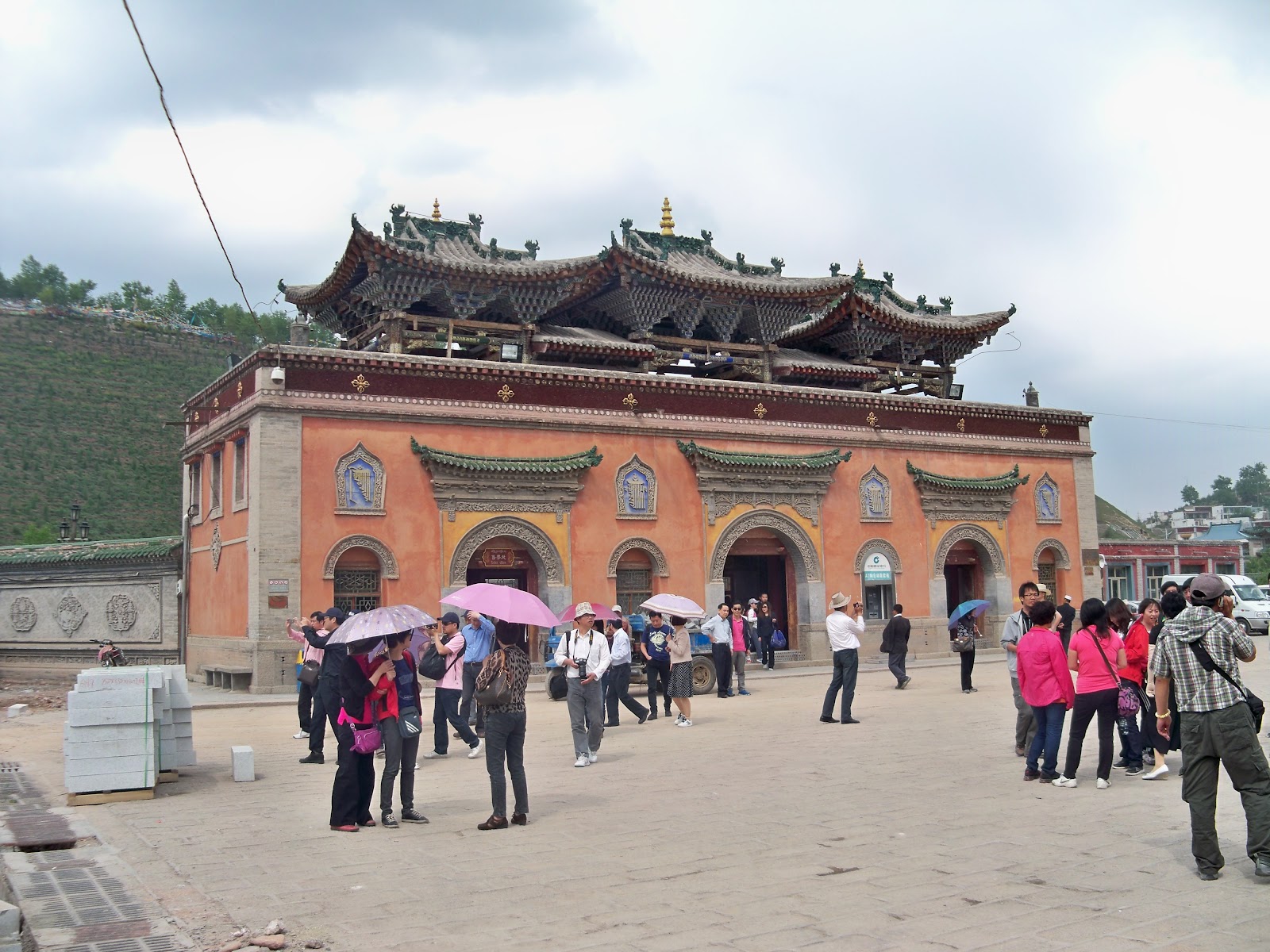
The Ta'er Monastery is a group of fine buildings in a combination of both the Han and Tibetan styles of architecture on the mountain slopes. It has lofty temples and halls rising one upon another. The palace buildings, Buddhist halls, sleeping quarters, as well as the courtyards echo each other and thus enhance the beauty of the whole area.


to be continued

Wednesday, June 27, 2012

THE SILK ROAD TOUR - continued


Day 6   3rd June 2012
-Jiayuguan pass


Located about six kilometers (four miles) southwest of Jiangyuguan City in Gansu Province, the Jiayuguan Pass (Jiayuguan in Chinese) represents the western starting point of a section of the Great Wall constructed during the Ming Dynasty (1368-1644). The pass covers an area of 33,500 square meters (eight acres) and lies at the base of a narrow valley, and takes its name from one of the surrounding hills, the Jiayu. Commonly referred to as the finest example of its kind on earth, the pass is the best preserved of the Great Wall's ancient military fortresses.

The Jiayuguan Pass was constructed as far back as 1372. Legend has it that the official charged with overseeing the building of the pass demanded that the foremen not squander a single brick. The builders were for the most part successful, and the project was finished with just one brick surplus to requirements. It was actually left at the site and has become famous among the tourists visiting the area.

The Jiayuguan Pass is constructed in three concentric layers: the central area is made up of an inner city, containing the largest of the pass' buildings; an outer city section, surrounded by a large wall dotted with watchtowers, turrets, and high-terrace pavilions; and finally, for purposes of defense, a moat. All of these features combined to make it a daunting prospect for any would-be attackers.


One brick remainder !


Dan Xia Colourful mountain in Zhangye. A mountain full of 'layered cakes'.


-Giant Buddha temple


Midway in the Hexi Corridor along the Silk Road lies the historic city of Zhangye, the centerpiece of which is the mysterious Giant Buddha Temple. Located in the southwest corner of Zhangye in Gansu Province, the Giant Buddha Temple is the largest architectural relic in Gansu Province of the Western Xia (1038-1227) period. China's largest reclining Buddha is well preserved in this temple. The Zhangye Museum is also located here.

Legend has it that a chancellor named Wei Mie of the Western Xia period ordered workers to dig into the ground to 1 to 1.3 meters deep to carve a reclining Buddha to be covered with glazed color tiles. The Giant Buddha Temple was built in 1098 to house the Buddha. In its 900 years the temple was restored many times during the Ming and Qing dynasties.


to be continued